DEFINITION
Dopamine receptors are a class of G protein-coupled receptors that are prominent in the vertebrate central nervous system (CNS). The neurotransmitter dopamine is the primary endogenous ligand for dopamine receptors.
Dopamine receptors are implicated in many neurological processes, including motivation, pleasure, cognition, memory, learning, and fine motor control, as well as modulation of neuroendocrine signaling. Abnormal dopamine receptor signaling and dopaminergic nerve function is implicated in several neuropsychiatric disorders. Thus, dopamine receptors are common neurologic drug targets; antipsychotics are often dopamine receptor antagonists while psychostimulants are typically indirect agonists of dopamine receptors.
History of Dopamine Receptors
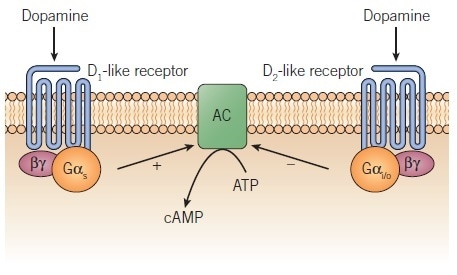
Regulation of adenylyl cyclase by D1-like and D2-like dopamine receptors. Image credit: Tocris Bioscience
An Overview of Dopamine Receptor Pharmacology, 2020
dopamine receptors in vascular tissue

THE GENE
CHEMICAL STRUCTURE AND IMAGES
When relevant for the function
- Primary structure
- Secondary structure
- Tertiary structure
- Quaternary structure
Protein Aminoacids Percentage (Width 700 px)


From the evolutionary point of view (Glu/Gln) they are quite similar.
DRD2 has a significantly higher:
- methionine (high protein synthesis, high mTOR)
- histidine
- thyrosine (high BH4 and NADPH)
and a lower:
Less pyruvate (glucose) available, slower oxidative metabolism?
h3. SYNTHESIS AND TURNOVER
mRNA synthesis
protein synthesis
post-translational modifications
degradation
CELLULAR FUNCTIONS
cellular localization

biological function
Novel insights in dopamine receptor physiology. 2007
- Abstract
The dopaminergic system has a pivotal role in the central nervous system but also plays important roles in the periphery, mainly in the endocrine system. Dopamine exerts its functions via five different receptors, named D(1)-D(5), belonging to the category of G protein coupled membrane receptors. Dopamine receptors are heterogeneously expressed in different cells, tissues and organs, where they stimulate or inhibit different functions, including neurotransmission and hormone synthesis and secretion. In particular, the dopamineric system has a pivotal role in the physiological regulation of the hypothalamus-pituitary-adrenal axis. Recent data have demonstrated the expression and function of dopamine receptors not only in endocrine organs but also in endocrine tumors, mainly those belonging to the hypothalamus-pituitary-adrenal axis, and also in the so-called 'neuroendocrine' tumors. These data confirm the important role of the dopaminergic system in this endocrine axis, as well as in the neuroendocrine system. This review summarizes the main structural and functional characteristics of dopamine receptors, emphasizing the most recent novelties, and focused on the physiological and pathological regulation of the hypothalamus-pituitary-adrenal axis by the dopaminergic system. In addition, the recent findings on the relationship between dopamine receptors and neuroendocrine tumors are summarized.
The dopaminergic system in hypertension, 2007
Abstract
Dopamine plays an important role in the pathogenesis of hypertension by regulating epithelial sodium transport, vascular smooth muscle contractility and production of reactive oxygen species and by interacting with the renin-angiotensin and sympathetic nervous systems. Dopamine receptors are classified into D(1)-like (D(1) and D(5)) and D(2)-like (D(2), D(3) and D(4)) subtypes based on their structure and pharmacology. Each of the dopamine receptor subtypes participates in the regulation of blood pressure by mechanisms specific for the subtype. Some receptors regulate blood pressure by influencing the central and/or peripheral nervous system; others influence epithelial transport and regulate the secretion and receptors of several humoral agents. This review summarizes the physiology of the different dopamine receptors in the regulation of blood pressure, and the relationship between dopamine receptor subtypes and hypertension.
- Cell signaling and Ligand transport
- Structural proteins
REGULATION
DIAGNOSTIC USE
